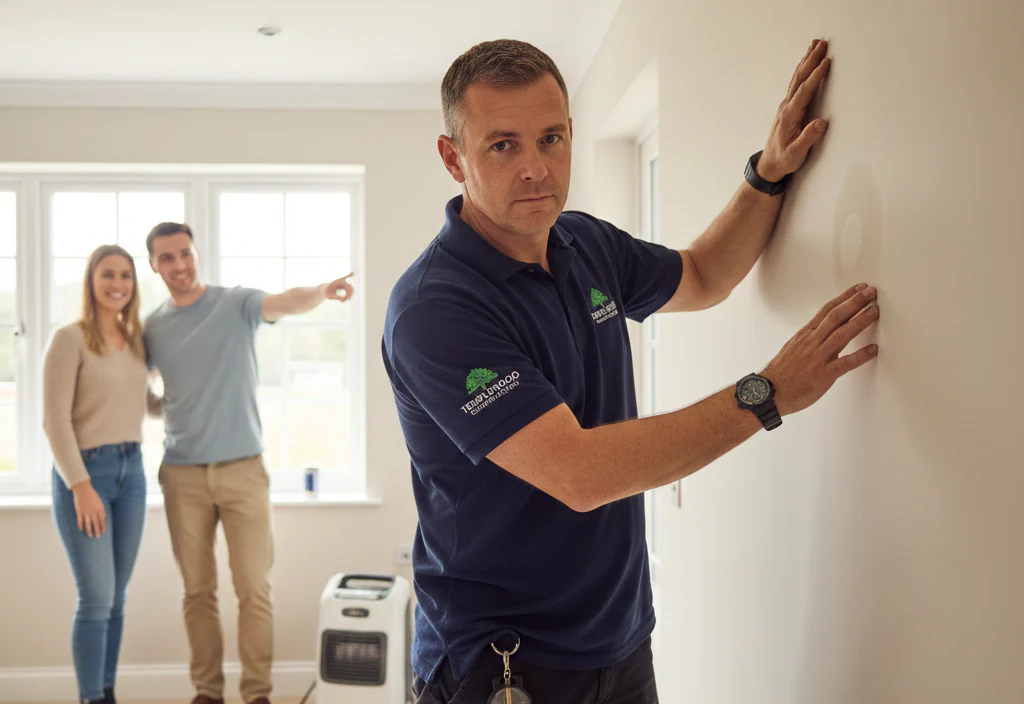

Dealing with Damp in UK

🇬🇧 Dealing with Damp: A Matter-of-Fact Guide to Removing Wall Moisture and Preventing Stains

As the owner of Templewood Construction, a specialist in extensions and loft conversions across Nottinghamshire and the East Midlands, I have seen the damage that unchecked moisture can inflict on a property. 

My experience instilled in me the necessity of identifying and neutralising a problem at its source—a principle that applies just as much to combat as it does to construction. Damp is not merely an aesthetic issue; it can compromise the integrity of your property and create an unhealthy living environment. Dealing with it requires a measured, two-phase approach: Effective Removal and Systematic Prevention.

Phase I: Effective Moisture Removal

Before any cosmetic repair can be considered, the wall must be thoroughly dried, and the underlying cause must be identified and eliminated. Painting over damp is a temporary cover-up; it is a tactical error that will only allow the problem to resurface with more severe consequences.

1. Pinpoint the Source (Root Cause Analysis)

Moisture ingress must be definitively identified before you can apply the correct solution. The three primary forms in the UK are:

  • Condensation: The most common form, caused by warm, moist internal air meeting cold surfaces (often in kitchens, bathrooms, and unheated rooms).
  • Penetrating Damp: Water entering from outside due to a defect in the building fabric (e.g., faulty guttering, damaged roof tiles, cracked render, poor pointing, or defective seals around windows).
  • Rising Damp: Less common but more serious, where groundwater moves up through the masonry due to a failed or non-existent damp-proof course (DPC).

If the source is penetrating or rising damp, this must be addressed by a competent professional before moving forward.

2. Drying the Affected Area

Once the source is addressed (e.g., the leak is fixed, or external repairs are complete), you can focus on drying the internal wall:

  • Increase Ventilation: Maximise airflow. Open windows (even just trickle vents) and internal doors. This allows moist air to escape.
  • Apply Targeted Heat: Gently increase the room temperature. Warm air holds more moisture, allowing it to be evaporated from the wall and subsequently vented out.
  • Deploy Dehumidifiers: Industrial-grade dehumidifiers are highly effective. They pull the moisture out of the air, which in turn draws moisture from the porous wall material. For severe issues, professional drying equipment may be necessary.
  • Remove Contaminated Plaster: In cases of rising damp or severe water damage, the plasterwork is likely to be contaminated with hygroscopic salts from the ground. These salts attract and hold moisture from the air, causing the stain to reappear even after the water source is fixed. The contaminated plaster must be stripped back to the bare masonry (typically one metre above the damp line).

Phase II: Preventing Stains from Returning

Preventing recurrence is about control and preparation. You must manage the water ingress and the internal humidity.

3. Professional Treatment of the Wall

For walls where plaster has been removed due to rising damp, the following is mandatory:

  • Apply a Salt Inhibitor/Tanking Slurry: Once the masonry is dry, a cementitious tanking slurry or a damp-proof membrane must be applied. This creates an impermeable, waterproof barrier before replastering.
  • Use Specialist Plaster: Re-plaster with a cement-based render incorporating a salt-retardant additive. This prevents residual salts from migrating and causing new stains.

For walls affected by condensation, which is often salt-free:

  • Apply a Stain-Blocking Primer: Use a high-quality, shellac-based or oil-based stain-blocking primer, such as Zinsser BIN or Coverstain, directly over the dried stain area (after any mould has been safely cleaned with a fungicide wash, never painted over). This seals the water-soluble compounds that cause the discolouration.

4. Systemic Moisture Management

The long-term solution lies in managing internal humidity and maintaining the building envelope:

  • Improve Ventilation Systematically: Install or upgrade extractor fans in kitchens and bathrooms (operated by a humidistat or linked to the light switch with a run-on timer). Consider a Positive Input Ventilation (PIV) unit for older properties to manage whole-house airflow.
  • Maintain Exterior Integrity: Conduct regular, thorough checks of your roof, gutters, downpipes, and external rendering/pointing. A military mindset demands rigorous maintenance; small defects will inevitably become significant problems if left unchecked.
  • Heating Strategy: Maintain a consistent, moderate background heat throughout the house, avoiding extreme cold spots in unused rooms where condensation is guaranteed to form.

A Note on Project Delivery

This entire process—from initial fault identification to final re-plastering and decoration—must be executed with precision. Shortcuts in damp remediation are a false economy.

If you are considering a major refurbishment or an expansion—such as a loft conversion or extension—that may involve structural alterations or integrating new and old structures, the opportunity to address any potential damp issues systemically is ideal.

At Templewood Construction, we operate with a complete Design and Build service across Nottinghamshire and the East Midlands. My team’s military-honed discipline ensures that every potential issue, including damp and structural integrity, is anticipated and mitigated during the planning and architectural design phase. We do not commence work until the foundation of the project—the structure and its protection from the elements—is unassailable, guaranteeing a high-quality, durable, and stain-free final finish.

If your property requires a comprehensive transformation or if you need professional guidance on serious damp issues, I recommend you contact us. We manage every stage to ensure the highest standards are met, with no room for error.

Related Articles

Image
15 Valley Rd
Nottingham
NG5 3HQ
 
Call us
+44 (0) 115 795 0208
Image
15 Valley Rd
Nottingham
NG5 3HQ
 
Call us
+44 (0) 115 795 0208
Federation of Master Builders
CHAS Accredited Contrator
Image

Any questions? Call Us: +44 (0) 115 795 0208